


How to Choose an Artificial Grass Company in Austin: Questions to Ask Before You Sign
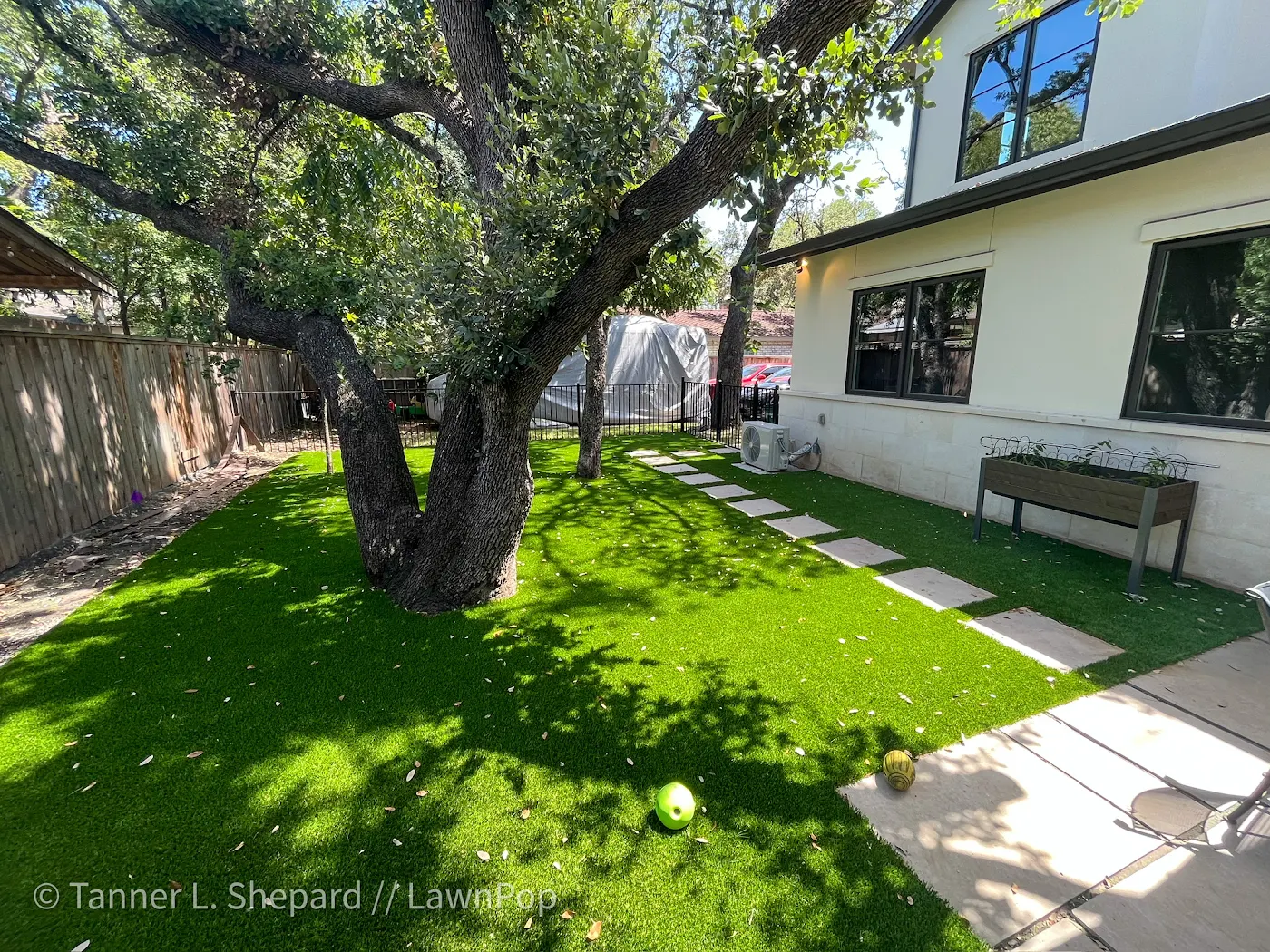
The best artificial grass company is the one that can explain, in plain terms, what goes under the turf, where the water goes, and how the edges and seams are finished. If you are comparing companies in the Austin area, these are the questions worth asking before you sign anything.
Key Takeaways
- Ask what happens below the turf first. Base prep and grading matter more than the surface.
- Central Texas limestone, clay soil, and heavy storms make drainage a real question, not a footnote.
- Compare written scopes line by line, not just the bottom number.
- Ask for the turf by product name, and make sure it fits your use: pets, play, putting, or looks.
- Credentials like Synthetic Turf Council membership are worth asking about, along with license, insurance, and references.
The part of the job you will never see again
Once turf is down, the base is buried. That is why it is the first thing to ask about.
A good installer should be able to tell you how they remove the existing lawn, what base material they use, how they compact it, and how they grade the surface so it is smooth and sheds water. In Austin, that conversation should include your soil. Limestone close to the surface and expansive clay both change how a site needs to be prepared.
If the answer is vague, that is useful information. “We just roll it out” is not a base prep plan.
Where water goes when an Austin storm hits
Central Texas swings between drought and downpour. Artificial grass helps with water bills and watering restrictions, but it still has to drain.
Ask how the company handles drainage on yards with clay soil, low spots, or slopes toward the house. Ask what happens at the edges of the installation. You want to hear specific answers tied to your yard, not a general promise that turf drains.
This is also where shade matters. Yards under cedar and oak trees collect leaves, and a yard that stays damp needs a plan. A company that has worked under Austin trees will bring it up before you do.
Seams, edges, and infill are where shortcuts show
From across the yard, most turf looks fine. Up close, the details separate good work from rushed work.
- Seams: Ask how seams are joined and where they will fall in your yard. Well-placed seams are hard to find. Poorly placed ones show up in the afternoon sun.
- Edges: Ask how the turf is secured and finished along beds, walkways, and fences. Clean, firm edges keep the lawn looking installed rather than laid down.
- Infill: Ask which infill they use and why. It affects how the lawn feels, how it holds up, and how it handles pets.
You do not need to be an expert. You just need a company that can answer without changing the subject.
Ask for the turf by name
“Premium turf” is not a product. A company should be able to tell you which turf it recommends for your yard and why.
LawnPop supplies and installs its own lineup, including LawnPop Evergreen, LawnPop Natural Premium Turf, LawnPop Southwest Turf, LawnPop Heavy Duty Multi Play Turf, and the Fresh Cut options. You can look through them on our products overview. The right pick depends on how you use the space. A dog run, a kids’ play area, and a front lawn facing an HOA do not need the same thing.
If you have dogs, start with our pet-friendly turf page. If you want a putting green, ask whether the company builds them regularly, because contouring and sand bunkers are a different skill from a flat lawn. Our putting green and golf simulator work is a good example of what that specialty looks like.
Credentials worth asking about
Any company can say it is professional. Look for things you can check.
LawnPop is a Synthetic Turf Council member and has been recognized as Best of Houzz. Those are facts you can verify, and it is fair to ask any company you are considering what memberships and recognition they hold.
Beyond that, ask for proof of license and insurance where applicable, ask for local references, and ask to see finished work in your area. We install across Austin and surrounding Central Texas, including Round Rock, Cedar Park, Georgetown, Leander, Pflugerville, Lakeway, Dripping Springs, Buda, and Kyle. A company that works near you will understand your neighborhood’s soil, trees, and HOA expectations.
A written scope beats a verbal promise
Two quotes can look far apart and still describe different jobs. Before you compare totals, compare what is actually included.
A clear written scope should spell out:
- Removal of the existing lawn or surface
- Base material and prep
- Drainage work, if needed
- Turf product by name
- Edging and border finishing
- Seaming and infill
- Cleanup
Ask about warranty coverage and get it in writing too. If a company tells you something verbally that is not on paper, ask them to add it.
For a general sense of what drives the number, see our page on the cost of artificial grass. It explains the factors without guessing at your yard. Financing is also offered if you want to spread the project out, and you can ask about it when you request your estimate.
Questions specific to your yard
Good companies ask you questions too. Expect them to ask about:
- Dogs: How many, how big, and where they go in the yard.
- Shade: Where the oaks and cedars are, and how much debris falls.
- HOA rules: Whether your community has appearance standards or an approval process.
- Use: Whether the lawn is for looks, play, pets, or all three.
- Care: How you plan to keep it up. Our Turf Refresh Program covers maintenance if you want help after installation.
If a company gives you a quote without learning anything about your yard, the quote is a guess.
Warning signs at the back fence
A few things should slow you down:
- Pressure to sign the same day
- No explanation of base prep or drainage
- A quote with one line and no detail
- No named turf product
- Reluctance to show past work or provide references
- Claims that sound too good, like promises about timelines or results nobody can guarantee for your specific yard
We would rather you ask hard questions and feel good about your choice. Our frequently asked questions page covers many of the basics, and you can see how we approach the work on our artificial grass installation page.
Talk to LawnPop
If you want to see how we answer these questions for your yard, call us at (512) 298-0933 or request a free estimate. We will talk through your soil, drainage, shade, pets, and goals, and give you a written plan you can compare against any other company.
Frequently Asked Questions
What is the most important thing to ask an artificial grass company?
Ask what they do below the turf. Excavation, base material, compaction, and grading decide how the lawn drains and how flat it stays. A company that can explain that process step by step is a better bet than one that only talks about the turf product.
Should I get more than one quote for artificial grass in Austin?
Yes. Compare written scopes, not just totals. Check that each quote lists base prep, drainage, edging, seaming, infill, and removal of your old lawn, so you are comparing the same job.
Does LawnPop offer financing?
Yes, financing is offered. Call (512) 298-0933 or request a free estimate to talk through your options.
Which areas does LawnPop serve?
LawnPop serves Austin and surrounding Central Texas, including Round Rock, Cedar Park, Georgetown, Leander, Pflugerville, Lakeway, Bee Cave, Dripping Springs, Buda, Kyle, San Marcos, and New Braunfels.
Can one company handle pet turf, putting greens, and playgrounds?
It depends on the company. Each project type has different needs, such as pet odor control, contoured putting surfaces, or play area surfacing. Ask to see how a company approaches the specific project you have in mind.
How do I know what an artificial grass project will cost?
Cost depends on the size and shape of your yard, the condition of the soil, the amount of base prep, the turf you choose, and any extras like edging or drainage work. The most reliable way to get a real number is a free estimate for your property.